No One Wins in Nuclear War: Social Simulations of High-stakes Military Decision-making
Publication
No One Wins in Nuclear War: Social Simulations of High-stakes Military Decision-making
A social-simulation environment for studying how organizations make high-stakes decisions, built on a deterministic, replay-validated rules engine and using wargames as the vehicle.
The WOPR repository opens with the camera-ready release.
Abstract
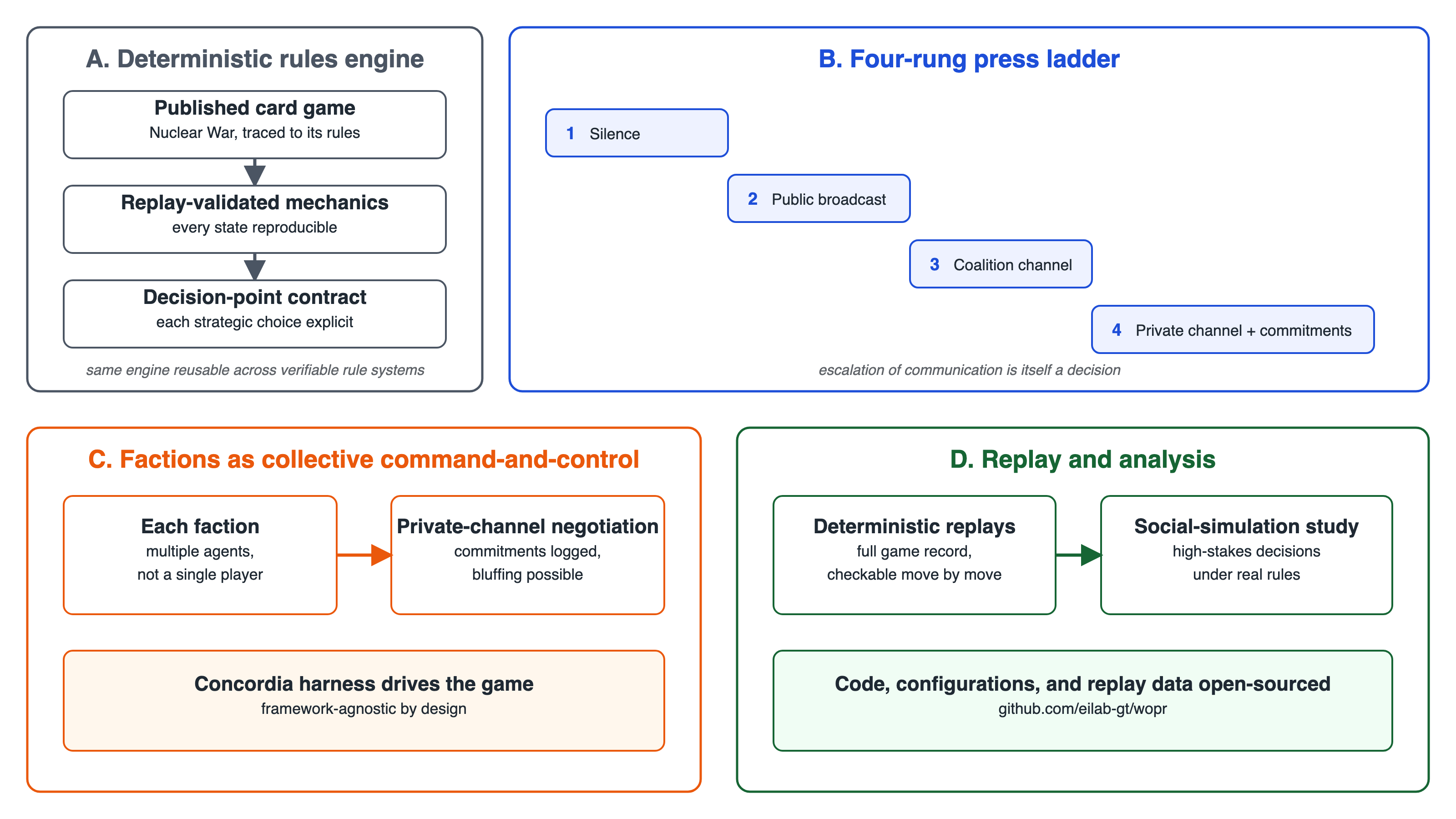
WOPR is a social-simulation environment for studying how organizations make high-stakes decisions, built on a deterministic, replay-validated rules engine and using wargames as the vehicle. We instantiate it first with the published card game Nuclear War, traced against its published rules. We start with military decision-making because of its safety implications and because it needs further study, but the design is not specific to it: the decision-point contract that exposes the engine to agents is reusable across verifiable rule systems. Existing social-simulation work emphasizes persona fidelity and synthetic opinion, but lacks a verifiable rules engine with replay-checkable mechanics and private-channel negotiation. WOPR supplies that engine, and its contract makes every strategic choice an explicit agent decision. The method is agnostic to social-simulation frameworks; we adopt Concordia as the default harness for driving the game. On the same engine, WOPR layers a four-rung press ladder from silence to private single-recipient channels with structured commitments, and instantiates each faction as a collective command-and-control system rather than a single agent. We make all code, example configurations, and replay data publicly available at github.com/eilab-gt/wopr.
At a Glance
- A deterministic, replay-validated rules engine traced against the published card game Nuclear War
- A decision-point contract that makes every strategic choice an explicit agent decision, reusable across verifiable rule systems
- A four-rung press ladder from silence to private single-recipient channels with structured commitments
- Each faction modeled as a collective command-and-control system rather than a single agent
Cite This Paper
BibTeX
@inproceedings{matlin2026nuclearwar,
  title     = {No One Wins in Nuclear War: Social Simulations of High-stakes Military Decision-making},
  author    = {Matlin, Glenn and Song, Isaac and Zang, Anthony Wen-Ming and Riedl, Mark},
  year      = {2026},
  booktitle = {Social Simulation with LLMs: Fidelity in Applications Workshop at the 3rd Conference on Language Models (COLM)}
}