Do Language Models Agree with Human Perceptions of Suspense in Stories?
Publication
Do Language Models Agree with Human Perceptions of Suspense in Stories?
Replicating four seminal psychology studies with language models: LMs can tell whether a text is suspenseful, but not how suspenseful, nor how suspense rises and falls.
Abstract
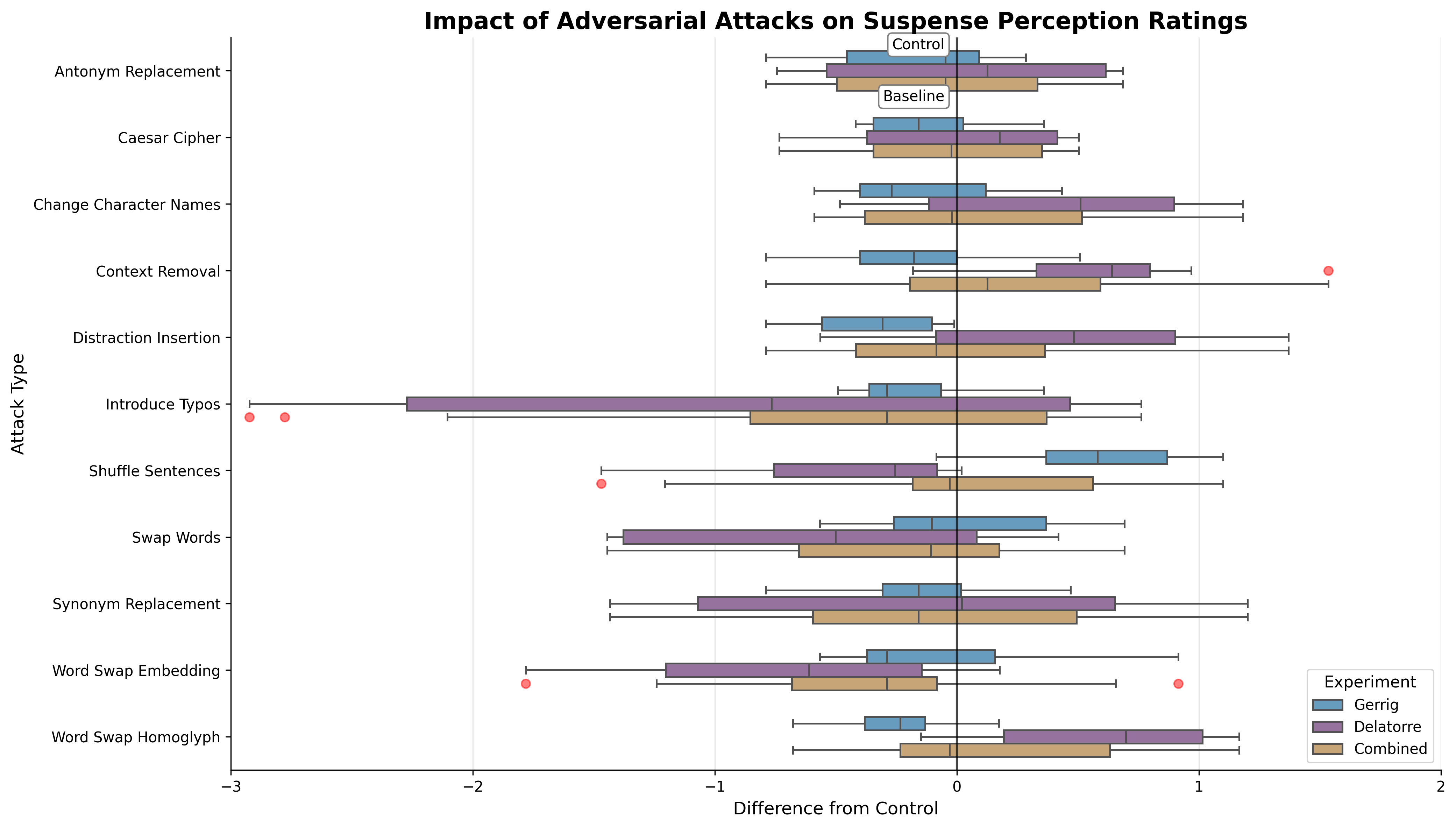
Suspense is an affective response to narrative text that is believed to involve complex cognitive processes in humans. Several psychological models have been developed to describe this phenomenon and the circumstances under which text might trigger it. We replicate four seminal psychological studies of human perceptions of suspense, substituting human responses with those of different open-weight and closed-source LMs. We conclude that while LMs can distinguish whether a text is intended to induce suspense in people, LMs cannot accurately estimate the relative amount of suspense within a text sequence as compared to human judgments, nor can LMs properly capture the human perception for the rise and fall of suspense across multiple text segments. We probe the abilities of LM suspense understanding by adversarially permuting the story text to identify what cause human and LM perceptions of suspense to diverge. We conclude that, while LMs can superficially identify and track certain facets of suspense, they do not process suspense in the same way as human readers.
At a Glance
- Four seminal psychology studies replicated with open-weight and closed-source LMs in place of human subjects
- LMs can distinguish whether a text is intended to induce suspense
- LMs cannot estimate relative suspense within a sequence, nor track its rise and fall across segments
- Adversarial permutations of story text reveal where human and model perceptions diverge
Cite This Paper
BibTeX
@inproceedings{matlin2025suspense,
  title     = {Do Language Models Agree with Human Perceptions of Suspense in Stories?},
  author    = {Matlin, Glenn and Zhang, Devin and Loza, Rodrigo Barroso and Popescu, Diana M. and Isbell, Joni and Chakraborty, Chandreyi and Riedl, Mark},
  booktitle = {2nd Conference on Language Models (COLM)},
  year      = {2025}
}